
Baralacha Pass
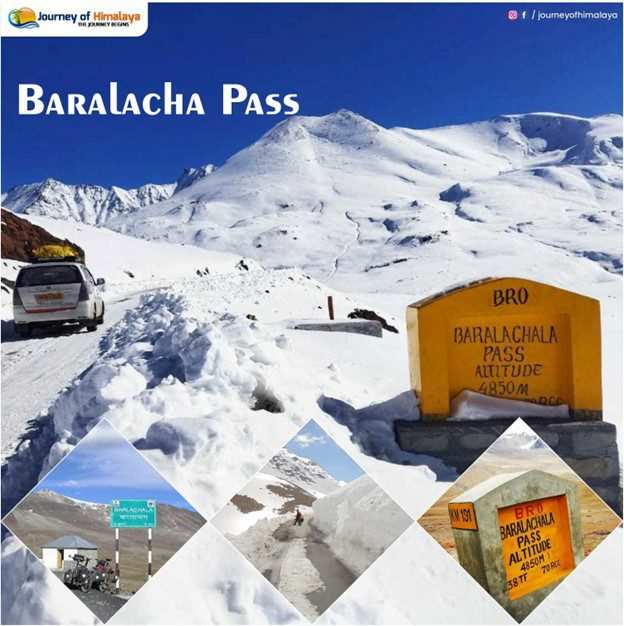
Baralacha Pass: The Ultimate Guide to Baralacha Pass
Baralacha Pass is a monumental entrance to the range of Zanskar, perched at an astounding height at the junction between the earth and the heavens. Commonly known as Baralacha La, it is a high mountain route that is an important arterial route between the Lahaul region in Himachal Pradesh and the Ladakh region. A Manali to Baralacha Pass trip is not just another stopover for those who want to experience the pure and unadulterated beauty of the Himalayas. It is a place that challenges your soul and rewards your vision with views that appear on a different planet.
Geographical Wonderland of the Crossroads
Name of Baralacha means a pass with crossroads. This is so because it is the crossing point of trails that have penetrated Tibet, Ladakh, Spiti and Lahaul. It stands at an elevation of approximately 4,890 meters, which makes it one of the highest passes that can be traversed by motor in the world. The topography is characterised by sharp mountains, huge glaciers, and high desert quietness. It is also the source of some of the biggest rivers such as the Bhaga and Chandra, which later join to make the Chenab River.
Planning Your Adventure from Manali
The majority of the travellers start their trip with the green valleys of Kullu. A Manali to Baralacha Pass is a journey between the green cedar forests and the brown and white landscape of the high Himalayas. It is an iconic journey and goes through the Atal Tunnel or the twisted routes of Rohtang, whichever route you take to your mind. The farther away you are from the civilisation of Manali, the lighter the air gets, and the more picturesque the topography. It becomes one of the most popular destinations among bikers and road-trip fanatics who are willing to encounter the adventure of the Leh-Manali Highway.
Understanding of the Logistics and Distance
Time counts when you are structuring your itinerary since the mountain roads are unpredictable. Manali to Baralacha Pass distance is about 145 kilometres. This can be a day-long journey over a short distance in the plains, and in this instance, it can be between 4 and 5 hours. Such reasons include BRO road building, crossings of water created by melting glaciers and steep gradients, and your average speed will be much slower. The best thing is to stop at Jispa or Keylong, and have a night, so that your body may have time to get accustomed to greater elevation, before you can attempt to reach the pass.
Baralacha Pass Attractions and Highlights
The landscape around the pass is rich with natural marvels which cannot be ignored. Suraj Tal Lake is among the best Baralacha Pass attractions. It is the third-highest lake in India, and it is frozen throughout most of the year, with an emerald-green body of water. The experience of watching the sun set on the ice-cold water of Suraj Tal is a religious one. Other interesting places to visit along the way would include the Deepak Tal lake. Where the reflections of the surrounding mountains are clearly visible. The pass in itself offers a 360-degree view of the Zanskar, Pir Panjal and the Great Himalayan ranges and is a paradise for landscape photographers.
Weather and the Best Time to Visit
Weather conditions here are extreme. Even the Baralacha temperature does not often rise beyond 15 degrees Celsius during the hottest season. During the months of June and July, particularly at night, the mercury can easily get down to the level of freezing temperatures.
At the top, heavy winds are always a constant companion which can make the temperature of the real feel a lot colder than indicated by the thermometer.
- The pass is only available to vehicles during the season (summer) (June to September).
- Rain is unusual particularly in monsoon months, yet this area is in a rain shadow; thus it is relatively dry.
- During winter, the pass is covered with up to 15 to 20 feet of snow and the road is entirely inaccessible between November and the end of May.
Transportation Guide: How to Go to Baralacha Pass
In case you are wondering how to go to Baralacha Pass, there are a few different ways to go, which depend on your budget and adventurous spirit.
- Personal taxis: The best mode of transportation is to hire a rugged SUV such as a Scorpio or Innova, which is available in Manali.
- Bikes: A large number of adventurers hire Royal Enfields in Manali and attempt to undertake the hairpin roads and water crossings themselves.
- HPTDC Buses: The Himachal Pradesh Tourism Development Corporation also has luxury and semi-luxury bus services which will drop off at the pass and travel between Leh and Manali.
- Shared Jeeps: There are shared Jeeps that operate local routes between Keylong and Leh, and which offer an alternative that is cheaper for the single traveller.
High Altitude Safety Tips
To reach almost 16,040 feet, one has to be prepared. There is a danger of Acute Mountain Sickness (AMS). It is recommended that travellers bring portable oxygen cylinders and keep themselves hydrated.
- It is important not to sleep at the pass itself but to go down to a lower level such as Jispa or Sarchu to sleep.
- Carry thick woollens, windcheaters, waterproof boots, even though you may be on your way in full summer.
- Always carry spare fuel and simple mechanical equipment in case you are driving your own car since there are no fuel pumps between Tandi and Karu.
The roads are not safe either and landslides can lead to temporarily closed roads, which is why it is a good practice to check the status of the roads with the Border Roads Organisation (BRO) before initiating your trip.
The Cultural Significance of the Region
In addition to the physical beauty, Baralacha La has a legend in the local folklore. The Chandra and Bhaga rivers are said to be the rivers of two lovers, Chandra, the daughter of the moon and Bhaga, the son of the sun. Their heavenly marriage is reported to have occurred at Tandi after they had descended the Baralacha heights. This gives a twist of romanticism and mysticism to the otherwise rough and rocky landscape.
Summary of the Journey:
The hike or the journey to Baralacha Pass with Journey Of Himalaya is a praise of the magnificence of nature. It is a destination where you are tiny when compared to the old mountains. Be it the blue waters of Suraj Tal that leave you spell-bound or the excitement of crossing the crossroads of the Himalayas, the experience remains with you even after the snow has melted from your boots.
FAQ’s:-
Q1. Am I required to have a permit to see Baralacha Pass?
Yes, tourists should get the Rohtang Pass authorisation or the Beyond Rohtang permit in case they are traversing Manali. One can apply for these online on the Himachal Pradesh government portal.
Q2. Does the pass have mobile connectivity?
Beyond Jispa, the mobile network is atrociously slow or dead. The postpaid connections of BSNL may indicate some signal in certain areas, but it is better to advise your family beforehand that you will be out of the grid.
Q3. Is it possible to go to Baralacha Pass in December?
No, the pass is closed in the month of December because there is a lot of snow. By late October or early November, the roads are normally blocked and do not open until the BRO clears the snow in late May or early June.
Q4. What food does the pass have to offer?
Permanent structures are very few. Tents are set up at Bharatpur and Sarchu during the tourist season with temporary “Dhabas”. They usually sell simple food such as Maggi, dal-rice and tea.
Q5. Is it safe for children and older people?
It may be very difficult due to low levels of oxygen in the air and due to the low temperatures of the ice where it is frozen, especially when very young children or very old people with respiratory or heart disorders are involved. Before planning a Manali tour package to such a high altitude, it is compulsory to consult a doctor.
- Get in Touch
More Destinations